How Mississippi Solved its Literacy Crisis
The state ranked 49th in reading in 2013. By 2025, it ranked 9th. Mississippi is no longer the butt of the joke, and other states should be taking notes.
If you google "why is Mississippi ______" google will fill in the blank. Why is Mississippi the poorest state? Why is Mississippi the worst state? In the face of all that internet prejudice, the fill-in-the-blank should read "Why is Mississippi's education system so successful?"
Mississippi has routinely ranked at the bottom in educational achievement. In 2013, it ranked 49th in reading; by 2025, it had jumped to 9th.
This story has gained traction in education circles, with the Harvard Graduate School of Education devoting a deep dive to the program on its EdCast podcast. But despite the enthusiasm, Mississippi's "miracle" has yet to catch on as a mainstream model.
Mississippi's miracle program
Mississippi's 2013 Literacy-Based Promotion Act (LBPA) takes much of the credit for the state's massive jump in achievement.
Mississippi did not create this program from scratch. It borrowed from Florida's 2002 literacy law and other educational best practices to build a comprehensive curriculum, testing, and training regime across the state.
Mississippi's program focuses on third graders and emphasizes three pillars: teacher training; identifying and supporting students with reading deficiencies; and holding back third-graders who are not performing at grade level.
Intense and mandatory teacher training has been essential to improving outcomes. Mississippi now requires kindergarten through third-grade teachers, elementary principals, and assistant principals to take a 55-hour training course on the "science of reading." The approach focuses on phonemic awareness (sounding out words), phonics (connecting sounds to letters), reading fluency, vocabulary, and reading comprehension. Teachers were trained specifically on how to demonstrate these concepts to elementary students. The science of reading approach replaces the "whole language approach" which teaches children words as units, rather than breaking them down to individual sounds. 88% of teachers noted that the training led to a meaningful change in how they had been teaching literacy, so the trainings had to provide completely new material and strategies for teachers.
To raise up individual students, the state started screening for signs of reading deficiencies or dyslexia earlier. Screenings now begin in kindergarten to ensure early intervention for students who need additional support. One major shift was from focusing on achievement across a whole class to focusing on individual achievement. Rather than tracking the percentage of students passing reading tests, teachers were tasked with figuring out why a particular student was not passing, and what needed to be done. This kind of teaching requires close attention and individualized resources for struggling students. Mississippi hired more than 74 reading coaches and sent them to 126 schools, focusing on the 50 lowest-performing schools first to provide this individualized support.
More frequent testing for all students provided teachers with regular insight into student performance. Mississippi requires at least one reading screening test per year and encourages testing up to three times per year. When a student struggles on these tests or falls behind, immediate intervention is required. Teachers must notify parents right away and tell them what supplemental support is being provided. They are also required to give parents and guardians strategies to guide students at home, because education cannot stop when students leave the classroom. Across the board, these notification requirements led to increased efforts to engage the parents of struggling readers, so learning did not stop at the dismissal bell.
Testing benchmarks are hotly debated in education. Taking an opposite approach, Los Angeles public schools de-emphasized standardized testing in 2024. Critics of standardized tests believe they cause anxiety and undermine deep learning, because teachers spend all their time teaching to the test rather than ensuring students truly understand the material. But Mississippi's experience suggests the tests themselves can be an effective tool for targeting individualized support, so long as the ultimate goal remains comprehensive understanding.
Students who do not pass the reading test are held back, sent to summer literacy camps, and given another chance to pass after the summer. Despite the additional support, around 9.6% of third graders were held back after the 2018–2019 school year.
Implementation challenges
According to Kymyona Burk, the literacy director responsibile for launching the program, it took time to build the buy-in necessary for the consistency and capacity that would bring results.
The first two years focused on communication. Stakeholders needed to believe in the program and in the state's support in order to carry it out fully and faithfully. Teachers and administrators had to believe the changes were good for students, and that the Department of Education was there to support the schools, not punish them for poor performance.
The next common pitfall involves clear requirements and the funding to support them. Teacher training, for instance, needs clear, mandatory requirements coupled with the funding to provide the program. Burk initially thought schools would be reluctant to learn new best practices, but found the opposite to be true. Schools with struggling students wanted to be told exactly what they needed to do to improve. So Burk prioritized clear and mandatory guidance for administrators, teachers, parents, and district leaders on exactly what needed to be done.
Changes were hardest for teachers who had used their own methods and resources for a long time. They had to learn the "science of reading" method that was becoming the standard, and shift to the individual-achievement model, which requires much more time on each student.
With limited funding, Burk notes, there can only be a few very targeted requirements, and they must be mandatory.
Outcomes in Mississippi, by the numbers
Mississippi made comprehensive changes, but which changes mattered?
Noah Spencer, an economist at the University of Toronto, gathered data from National Assessment of Educational Progress (NAEP) assessments before and after the program's introduction to determine whether the LBPA actually deserves the credit and published his findings in the Econocmics of Education Review.
Spencer's analysis looked at fourth-grade reading and math scores on the NAEP, before and after the program. The synthetic difference-in-differences analysis controlled for demographic factors such as race, income, urban and rural settings, and parental education. Data was collected from all 50 states, isolating those with no early-literacy policy, or only limited ones, for comparison with Mississippi's program.
Several confounding factors may take some, but not all, of the credit for Mississippi's improvements. The state also invested in expanding pre-kindergarten access, new standardized testing requirements for all students, a new accountability system that assigned letter grades to schools and districts based on student growth, and resources to help parents of special-needs students cover private-school tuition or other support.
Even accounting for those factors, Spencer found that the LBPA led to an 8.5 point increase in reading scores and a 10.7 point improvement in math. These results suggest Mississippi's program was far more successful than the average early-literacy program studied in the past. Most of the program's success came from pulling students from below basic up to proficient reading levels. Math scores improved 1.3 times as much as reading, suggesting a complementary effect. Notably, the program had similar effects on students regardless of income level.
In Mississippi, holding students back was far more effective at improving reading scores than it has been in other states. Students held back in grade 3 saw a 42 point increase in scores by grade 6. But in Chicago, retaining students in third grade had no impact on achievement two years later, and students held back in New York saw only marginal improvements.
This suggests that holding a student back alone is not the key; rather, it was the comprehensive support Mississippi offered alongside repeating a year.
Why are other states still struggling?
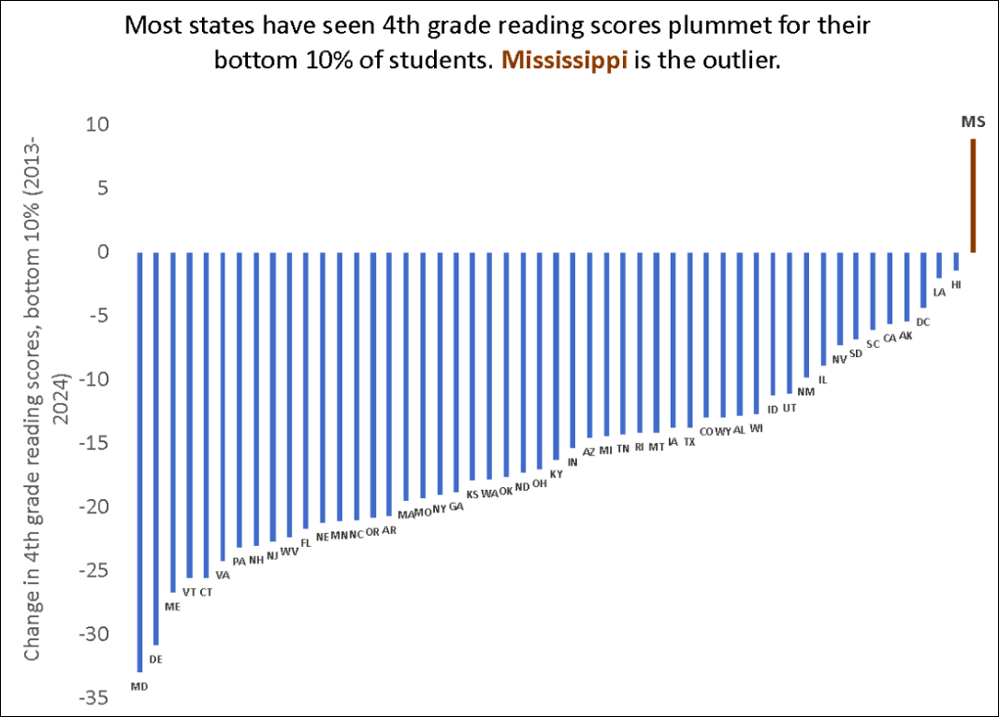
Reading levels began to drop in most states starting in 2013, just as Mississippi was bringing its new model online. The pandemic accelerated these declines. Low-income districts saw the largest drops, but wealthier districts saw significant declines as well.
Nearly 45 states plus D.C. have adopted some version of the Mississippi model, but only 1 in 3 have returned to pre-Covid levels. All seven states plus D.C. that saw reading gains between 2022 and 2025 had implemented the "science of reading" methodology used in Mississippi. But it has not been a silver bullet everywhere: Florida, Arizona, and Nebraska adopted similar programs, yet their test scores continued to drop.
Even states with large budgets may not see gains if their policies include "a lot of mays versus shalls."Kymyona Burk, Mississippi's literacy director in 2013
Burk notes that even states with large budgets may not see gains if their policies include "a lot of mays versus shalls." The changes must be mandatory and enforced to produce meaningful improvement. The two years Mississippi spent on upfront communication and trust-building let it make its requirements mandatory without mass revolt; states that spend less time building buy-in tend to default to optional programs, which rarely lead to meaningful change.
Up until the mid-2010s, reading scores had been steadily on the rise. Researchers also attribute part of the decline to social media use. Teen use of social media and smartphones took off in the early 2010s, around the same time reading scores began to fall.The mid-2010s also marked the end of the Bush-era No Child Left Behind program. Unpopular as it was with educators, the program pushed schools to improve test scores, which in turn improved student achievement.
Despite the slow gains being made across the country, Mississippi's science-of-reading approach is the method of choice for the states seeing the most progress. With mandatory requirements, and lots of upfront communication to solicit buy-in across administrations, states could eventually start to see literacy rates exceeding pre-Covid figures.
Helpful resources for policymakers
2016 amended Mississippi Literacy-Based Promotion Act Mississippi universal literacy screening guide Maryland's new literacy policy implementation plan, focused on the science of reading Implementation plan and resources
Endnote
[1] In Spencer's report, one standard deviation equals 37 points on the NAEP test. A 0.23 SD improvement in reading translates to 8.5 points, and a 0.29 SD improvement in math translates to a 10.7 point improvement. Comprehensive early literacy policy and the "Mississippi Miracle," Noah Spencer, June 19, 2024.
More from The Effective

What reading programs that actually raise scores have in common
An analysis of thousands of schools that beat literacy expectations for their poverty levels finds a recurring set of practices, from protected instructional time to explicit foundational-skills teaching.
Denver hit its early literacy target and missed its 3-8 reading goal, four years after publishing both
Chalkbeat checks Denver Public Schools' 2022 strategic plan against the 2026 test results it promised to move.

Tulsa schools flag eviction filings so families get help before kids fall behind
A Tulsa Public Schools partnership with a local nonprofit alerts parents facing eviction to legal aid and rental assistance, aiming to keep children enrolled.